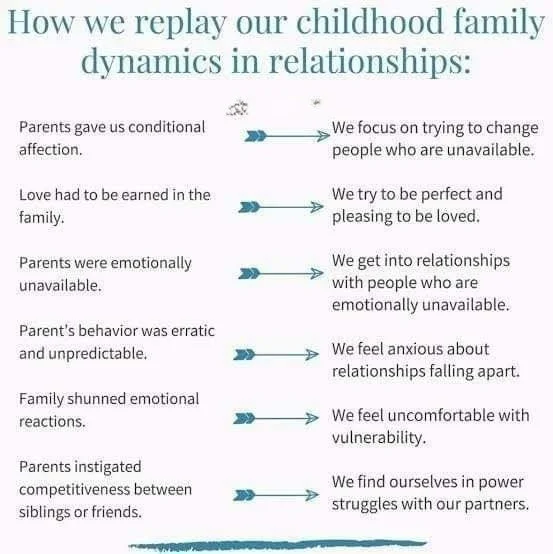
Have you ever found yourself reacting to a situation in a way that feels strangely familiar? Perhaps you withdraw when someone becomes angry, feel responsible for keeping everyone happy, or become anxious when someone you love seems emotionally distant. Sometimes, these responses have less to do with what is happening in the present and more to do with the relationships we experienced growing up.
Our earliest family relationships help shape our understanding of ourselves, others, and the world around us. As children, we learn how to seek connection, manage conflict, express emotions, and maintain a sense of belonging. Over time, these experiences can become familiar relational patterns that we carry into adulthood, often without recognizing their origins.
How Childhood Experiences Shape Adult Relationships
Attachment theory suggests that our early relationships influence the expectations we develop about emotional availability, trust, and security. These expectations are sometimes described as internal working models, which help us interpret and respond to relationships throughout life (Fraley, 2002).
For example, a child raised in a household where conflict was unpredictable may learn to monitor the emotions of others closely. This heightened awareness may have been an effective way to navigate childhood, but in adulthood, it can contribute to anxiety, people-pleasing, or difficulty expressing personal needs.
Similarly, a child who received affection primarily through achievement may develop the belief that love and acceptance must be earned. As an adult, this individual may struggle with perfectionism, self-criticism, or an ongoing need for reassurance.
These patterns are not necessarily conscious choices. They often represent ways of adapting to the emotional environment in which we developed.
Research supports an association between early relationship experiences and later emotional functioning in romantic partnerships. However, childhood experiences do not inevitably determine adult relationship outcomes (Simpson et al., 2007).
Why Familiar Patterns Can Be Difficult to Change
One of the more interesting aspects of human relationships is that what feels familiar does not always feel comfortable or healthy.
We may recognize that a particular relationship dynamic causes distress, yet find ourselves returning to similar emotional responses. Someone who learned to avoid conflict may continue suppressing their feelings, even within a supportive relationship. Someone who experienced inconsistent affection may become especially sensitive to perceived rejection or distance.
These patterns can reinforce themselves through the ways we interpret and respond to other people. For example, fearing rejection may lead someone to seek repeated reassurance, while fearing vulnerability may lead another person to withdraw. Either response can unintentionally create additional difficulties within a relationship.
Research on adult attachment demonstrates how anxiety about rejection and discomfort with emotional closeness can influence interactions between partners. Importantly, supportive relationship experiences can also help reduce these difficulties (Overall et al., 2022).
Understanding these dynamics is not about blaming our parents or viewing childhood as the sole explanation for adult difficulties. Rather, it is about recognizing that many behaviors developed for understandable reasons, even when they no longer serve us.
Recognizing and Changing Old Patterns
Meaningful change often begins with curiosity rather than criticism. Instead of asking, "Why do I keep doing this?" we might ask, "Where did I learn to respond this way, and what was this response protecting me from?"
Psychotherapy provides an opportunity to examine these patterns within a supportive and collaborative relationship. Through increased awareness, emotional processing, and the development of alternative responses, individuals can begin to distinguish between the expectations formed in childhood and the realities of their current relationships.
For some individuals, art therapy can provide an additional avenue for this exploration. Creating images of family relationships, mapping significant experiences, or visually representing recurring emotional patterns can make complex relational experiences more accessible for reflection. The creative process may help individuals explore emotions that are difficult to express through words alone.
Changing longstanding relational patterns does not necessarily mean eliminating our emotional responses. Instead, it involves learning to recognize them, understand their origins, and respond with greater flexibility and self-compassion.
We Are Not Destined to Repeat the Past
Although our early experiences influence us, they do not define the entirety of who we become. Attachment patterns can change as we develop new relationships, encounter different experiences, and deepen our understanding of ourselves (Fraley, 2002).
We cannot rewrite our childhood experiences, but we can change the relationship we have with those experiences. We can begin to recognize when an old emotional response no longer reflects our present circumstances and make more intentional choices about how we relate to others.
Perhaps one of the most meaningful aspects of psychotherapy is the opportunity to recognize that behaviors developed for survival or belonging in childhood do not have to remain our only ways of navigating relationships.
At Creative Psychotherapy Marin, we help individuals explore the relationship between past experiences and present emotional challenges. Through compassionate, evidence-informed psychotherapy, clients can develop greater self-awareness, healthier relationship patterns, and a more accepting relationship with themselves. We offer in-person therapy in San Rafael, Marin County, and telehealth throughout California.
References
Fraley, R. C. (2002). Attachment stability from infancy to adulthood: Meta-analysis and dynamic modeling of developmental mechanisms. Personality and Social Psychology Review, 6(2), 123–151. https://doi.org/10.1207/S15327957PSPR0602_03
Overall, N. C., Pietromonaco, P. R., & Simpson, J. A. (2022). Buffering and spillover of adult attachment insecurity in couple and family relationships. Nature Reviews Psychology, 1, 101–111. https://doi.org/10.1038/s44159-021-00011-1
Simpson, J. A., Collins, W. A., Tran, S., & Haydon, K. C. (2007). Attachment and the experience and expression of emotions in romantic relationships: A developmental perspective. Journal of Personality and Social Psychology, 92(2), 355–367. https://doi.org/10.1037/0022-3514.92.2.355